
Oh, the Places We've Been!

Here’s Dan with a recent harvest of Bixby,* one of his favorite varieties.
It’s also one of the first willows we began growing back in 2018. Those beautiful bundles are the culmination of diligently cultivating and coppicing our plants every year since then, and they have us thinking about all steps that led to how our acreage, and business, have become so salix-centric.
There were the early “bundles,” which were scarce and rather scraggly.

2020
And the motley crew of Dan’s very first baskets before that, which he wove just for fun using foraged materials from around the property, including blackberry canes, grapevines, and honeysuckle, as well as willow purchased from an established grower.

2019
But long before basketry, willow, and Foggy Blossom, we spent the first 6 years of our relationship growing in backyards - one very small, and one with more room to play. It seemed impossible that we’d ever be able to start a “real farm,” but the dream was always floating around our imaginations.

2012 & 2016
We grew the typical garden goodies back then, with our efforts simply serving one of our favorite hobbies. Our most successful endeavor was the fruit we grew at our last house, particularly the berries. Below you can see Dan gathering some in a glass pyrex, which was a far cry from much more aesthetic vessels he'd unknowingly one day make.

2016 & 2022 (a rib-style basket woven by Dan, holding a harvest of our white currants)
By the time we miraculously landed on the 12 acres that is now Foggy Blossom in 2017, we were ready to hit the ground running with a cut flower and annual vegetable (market garden) operation.

A long stretch of spinach
We used blueprints from leaders in each industry, scaling up to an ambitious level as we followed their curriculum. Having a clear path for those initial, and more traditional, farm dreams, gave us the confidence to build towards something tangible.

Flowers quickly became the area we gave the most attention, and within 2 years our field was full of thousands of incredibly stunning blossoms, most notably Dahlias.
Every fall we’d dig, process and divide piles upon piles of their finicky tubers. Were they worth the dirtiest, most tedious work?

Ultimately, no.

We gave up Dahlias for good at the end of 2020, but the abundance of beauty will always be missed. Back then I also did a bunch of botanical dye experiments, as well as what I called “bloomosaics” (collages of cut flowers I’d arrange and photograph).

Botanical dye swatches, an elderberry dyed silk scarf, and a trio of floral bloomosaics

Dahlias on the old corn crib door
We even started a YouTube channel to document our farming adventures, which we kept up for a little over a year. Looking back on those videos (now offline and tucked away on a hard drive) is the height of cringe, but we were earnestly trying to tell a story in real time as we were figuring it out.
Having an accountability source to articulate our thoughts into would ultimately serve as great practice for the presentations and artist talks that were in our future.

A go-to pose for YouTube thumbnails
We had nothing but time to explore our constantly shifting interests back then, and not pictured is our pottery phase, maple syrup tapping, apple cider pressing, fermentation experiments, mushroom foraging, canning, and so much more.
Creativity has always been the lens through which we feel our way through the world, and every meandering pursuit has deepened our relationship with this land.

Early work on seed starting and air prune boxes, and inside the freshly finished weaving studio once willow began to take over
We gave up annuals soon after starting them, pivoting to perennials instead and planting 100+ different species of fruits, nuts, flowers, herbaceous vegetables, and willow as quickly as we could. We’d become enchanted by their only plant me once sensibility, which was the exact opposite of start me from scratch every year annuals.
Little did we know that the perennial that would became the heart of Foggy Blossom was the one that needed an abundance of attention, which we’ve been happy to give.

Winter work - collecting hardwood cuttings, and coppicing rows and rows of willow
Whatever farm dreams were swirling around in our heads nearly 15 years ago didn’t look anything like our reality today. Back then we didn’t know that willow could be woven, or that hardwood cuttings were a viable way to propagate perennials.
We didn’t know that every exploration led by curiosity would lead to the development of a farming business that combines art and agriculture, which was what we were after all along.
What we do know is that we are excited as ever to see where we’ll go next.

Honeyberry, Gooseberry, Black Currants, Elderberry, Goumi - all in our cuttings shop
*P.S. The title of this post is a play on Oh, the Place’s You’ll Go! by Dr. Seuss, and I was shocked to see a familiar word once I started looking through it:
“So...
be your name Buxbaum or Bixby or Bray
or Mordecai Ali Van Allen O'Shea,
you're off to Great Places!
Today is your day!
Your mountain is waiting.
So...get on your way!”
Originally published on March 2, 2025
Set Back
adapting/advancing

After wrapping up fulfillment of our cuttings shop sales this past week, we enjoyed one idyllic day of harvesting before conditions collapsed under unexpected snow.
Of course snow is better than sweltering sunshine - given the fact that we’d like to lop off as many rods as possible before they begin to leaf out - but it throws a wrench in progress.
The other thing that hinders headway? Our own decisions.

taken 14 hours apart
This is the third year of harvesting these particular plants, which are some of our youngest, and our approach to leveling them has wavered each cycle.
There was a year of classic coppicing (cutting everything down to ground level), and another that was an experimental hybrid between coppicing and pollarding (cutting higher up, thus raising the height of the stem). Without a clear intention from the start, results have been mixed.
Here in year three, it feels pertinent to pivot back to coppicing, and reshape the stools.

a younger stool amongst a row of older ones, which have always been classically coppiced
A stool is what’s left of a willow plant once you’ve cut all its rods away. There are many approaches to this “tailoring,” and perhaps it’s sheer stubbornness that has us perpetually testing tactics outside of industry standards. Our attempts often end in a flop, or in this case the need for a course correction, but it always feel better to find out for ourselves, rather than follow a prescription with no questions asked.
Exploratory, meandering work yields extra insight, and if there’s one plant that’s forgiving of unconventional ideas, it’s willow.

plants that got the hybrid harvest treatment last year
The downside of this hybridized approach was the creation of a larger footprint of growth, which became hard for us to maneuver around. The greater width also meant the plants shaded themselves out, creating vulnerable dead zones on their stools. With a bit of extra, tedious attention, all will literally come back down to earth this season.
Each year of this work has been an education, but the greatest wisdom comes from truly examining our why.

a bundle of harvested Ovaro Udine
For a long time the goal was quantity, and every decision informed a need to create as much weaving material as possible to supply our classes and personal work. There’s a price to pay for propelling beyond a being’s capacity, however, and the results reflected that exploitation. Willow can be pushed in just about every direction, but maturity cannot be expedited.
The goal now is less rods of higher quality, and an increasingly simplified schedule.

the wide spectrum of this week’s weather
These quiet winter weeks have allowed for a lot of reflecting and listening in the fields, but with spring on the horizon, everything is about to wake up, and get loud.
Energy will rise from the depths, flooding the stools and shooting straight up through any remaining rods, making them robust with life. Harvesting willow vacated of vitality is a relative breeze, but the thickness of rejuvenation will challenge our tools, and we’ll inevitably question the pressure we put on ourselves to finish every row.
If we don’t get through them all, we’ll adapt.

There seems to be a recurring theme of winter desiring to make one last splash before it hands the baton off to its successor, and why not? The full expression of every season ideally leads to abundant growth, vigorous yields, significant chill hours, and enough space to step back and evaluate all successes, and set backs.
In these last dozen days of winter, honest assessment feels like advancement.
Originally published on March 9, 2025
Have Company
and get out of their way

As our marathon of harvesting plows through its final miles, all sorts of company is joining the fray.
Amphibians have begun to fill the air with their amorous noises at night, while Red-winged Blackbirds have returned, adding their signature trill to the daily mix, along with a splash of color.
Pussywillows are boldly sprouting their prominent fuzz on the plants we’ve left for pollinators, while the barely perceptible Hazelnut blossoms are showing their spindly, red legs. Amongst a tangle of trimmed Currant branches, Hellebores are fighting for their share of the sun, and our eyes are peeled for the first Daffodil of 2025.
This banquet of activity, served by the legions of life that exist here beyond willow, will only continue to increase its offerings.

Willow catkins | Hazelnut catkins
Working during dormancy feels like performing a segment of a relay race. We make our major moves after everything’s gone to bed for the year, taking the baton between the bookends of first and last frost, hoping to finish our objectives in peace and quiet, before the earth wakes up and takes back the wheel.
These mostly frozen months have felt like the creation of a first draft, as our efforts of subtraction have returned the willow field to a veritable blank canvas. Pretty soon we’ll pull our efforts back entirely, and the negative space will fill in with fresh growth.
All of our should’ves, and best intentions, will be sequestered until next year.
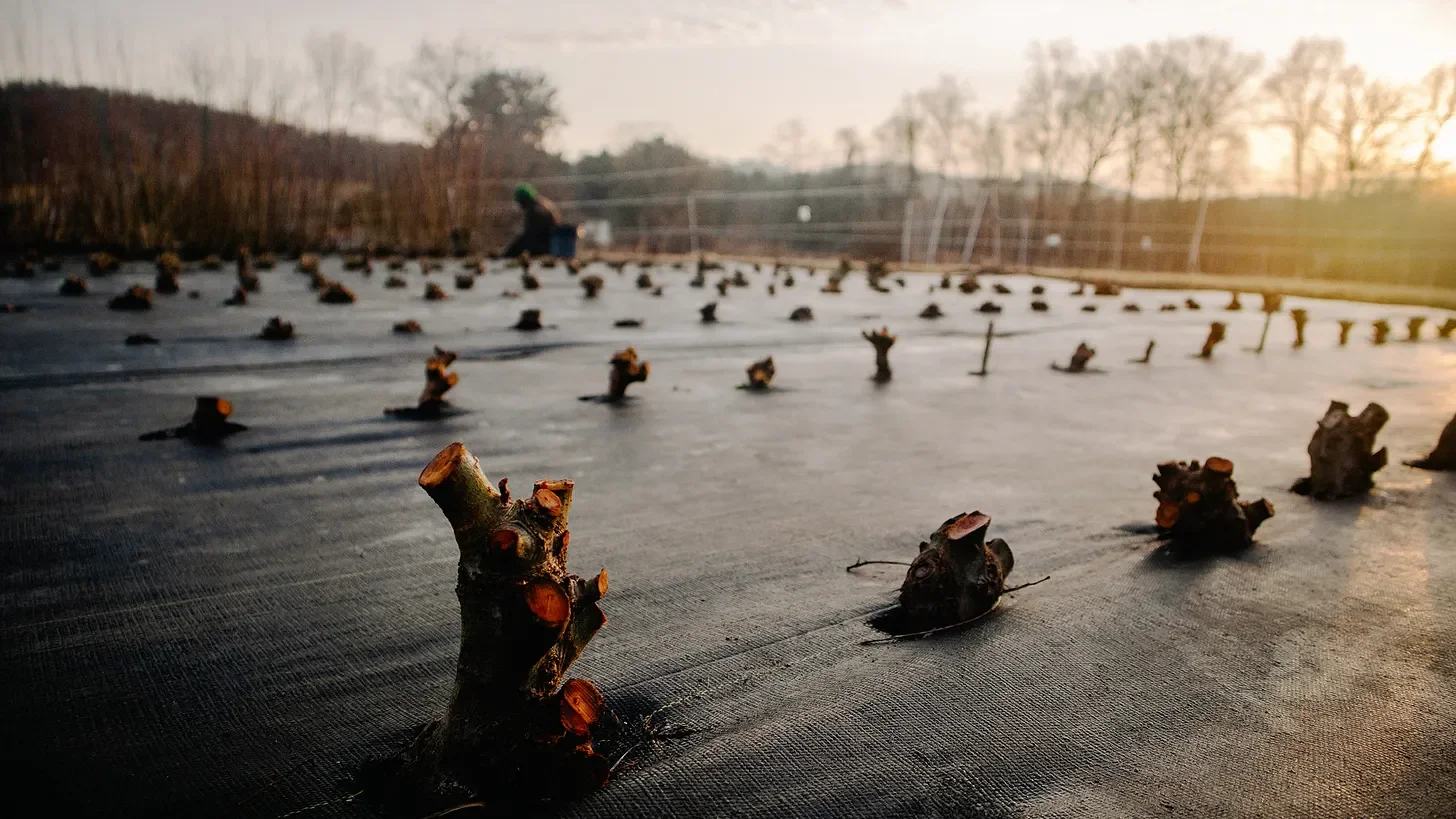
The anticipation of spring is palpable, and harvesting will be a true photo finish this season. With the unpredictability of weather, there isn’t any other way to get the job done, but racing against the clock is not without its enjoyment, or satisfaction.

As we finish up, green is getting ready to brush itself across the landscape. Last year’s death will become diluted by this year’s new life, setting the stage for all life forms to play upon. You can already hear the ground shifting to make room.
Layers of new and old bird songs will become even more inseparable, the chaos matched only by their behavior at the feeders. Ticks will reappear as a top of mind nuisance, and hopefully later than sooner, snakes will reemerge as well.
Our buckets will overflow with spring blooms, and the ponds will be full of floating frog eggs, then eager tadpoles. Another honeybee swarm may appear, or a myriad of other possibilities, all within the dependable, and unpredictable, world of spring.

When the new season has fully stepped into view, we’ll shift from harvesting to planting. The willow bundles will continue drying out in the shed, and we’ll work on preparing plans for upcoming workshops.
After that, our eyes will turn towards summer, which is our season to become the dormant ones in the fields. The hottest days will feel the most calm, creating ample time and space to notice all the action that’s just beginning to take shape now.

As these final winter mornings turn into days that include more chaotic company, we’re looking forward to getting out of their way, as the next leg of the race begins.
Originally published on March 16, 2025
The Unexpected
one hail of a storm
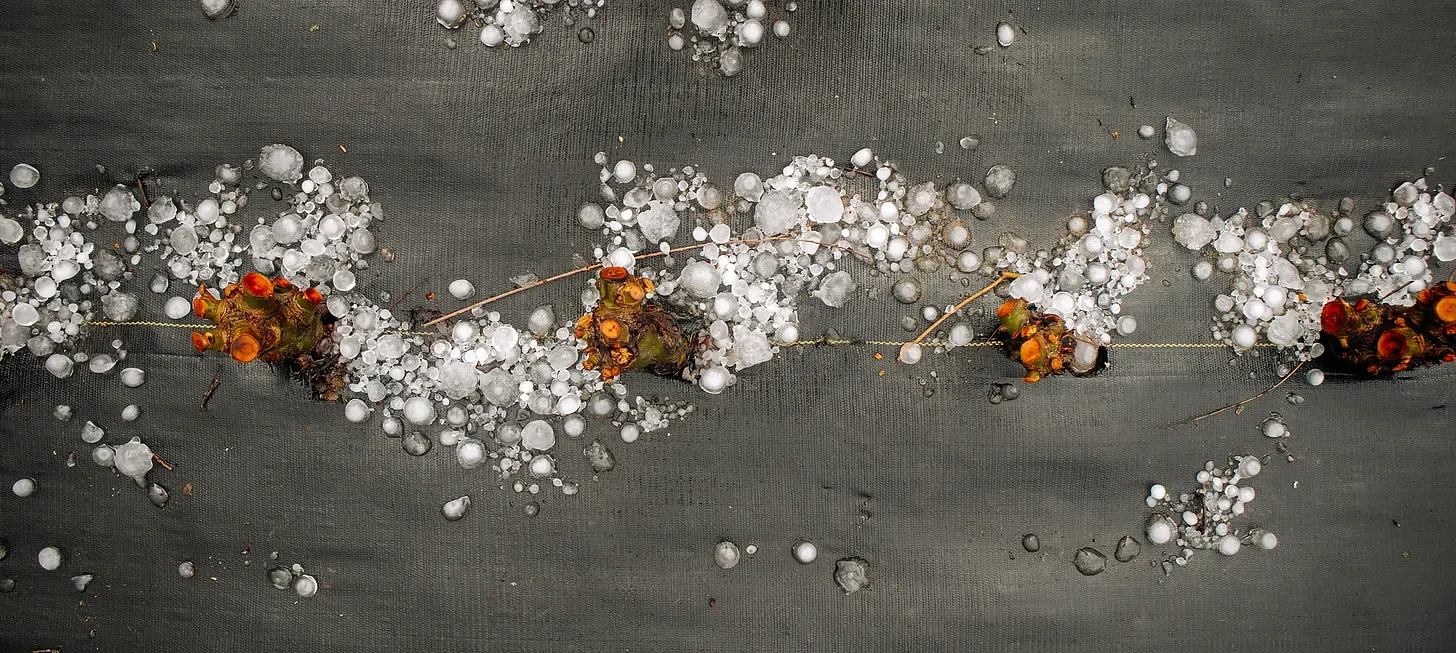
Last Sunday, we hunkered down in the center hallway of our house while a violent hail storm raged all around.
It sounded as if the glass in every window was about to explode, or as if the walls were going to be torn apart. The unbelievable, and unexpected, ferocity lasted for nearly 5 minutes. We were afraid, and could barely hear each other’s voices above the roar, but our almost entirely deaf and blind Border Terrier was enviably at peace in my arms.
The evidence melted within hours, leaving ominous, empty pockets in the ground. We’ve experienced quite a bit of hail over the years, but none like this. The next day it was confirmed that a handful of tornadoes had touched down in nearby counties.

hail dents in the ground, damage to the greenhouse roof
Ultimately, the siding and window frames on our house took a hit, along with our greenhouse (and our nervous systems). The damage also included rampant dimpling on every panel of our relatively new car, and a cracked windshield.
Contractor trucks and insurance agents have been roaming the roads every day, and our agent told us that the storm had been classified as a catastrophe.
Thankfully, all can be fixed.

Beyond the world of our possessions, the last section of willow awaiting harvest was hit hard, leaving branches scattered about in various states of being cracked, or fully broken. Most rods are salvageable, although aesthetically, they’re compromised.
Whatever gets woven with this material will showcase the scars of the storm.

The more years we spend on this land (this will be our 8th), the more repetitive the seasons tend to feel. We know the patterns, cast of characters, and sharing their stories can sometimes seem like a contrived inflation of the mundane.
When spring arrived in the wake of this turbulent action, however, the reliability of our expectations was set askew. We thought the transition from winter to spring would look one way, with dependable dips and lifts in temperature, but the unforeseen forces that swept through have refreshed our perception of the familiar.

a branch of pussywillows, bent from the storm
In addition to all that’s snapped and crooked, there are a few mammoth trees laying across our neighbor’s yards, too large to clean up by hand. Miraculously, though, most of our young buds stayed put on their branches, keeping the full potential intact.
The strength of the small, and the vulnerability of the mighty, sit in sharp contrast.

the first pair of Daffodils has arrived
On a nearly 80° afternoon, we crossed paths with the first snake of the year, still dusty from a long rest below the surface. When a firm frost returned the next day, I wondered if they wished they hadn’t come up so soon, but I suppose slithering between basking and brumation is an intrinsic wisdom, entirely inaccessible to us.
Our minds are always trying to predict what comes next, creating imaginary anchors to navigate around, and feel security from. When the unexpected hits, however, all forecasting goes out the window.

Dan initially wished he’d been able to get through this final section of harvesting before the storm hit, but after further contemplation, he realized the rods had likely protected the more permanent, and important parts of the plants closer to the ground.
Who knows what the repercussions, for us, would’ve been without those barriers. Undoubtedly, the willow would’ve continued onward, in their own way, just fine.

harvesting the final section of (pollarded) willow
We do know there will still be flowers, fruits, nuts and baskets this year, but from this freshly tilted perspective, we’re reminded that past experiences don’t dictate the dependability of the future.
Certainty can be erased in minutes, exposing the mirage it always was.
New narrative layers grow every day, and it’s the unexpected events that create significant demarcations in the story at large. This spring will be remembered for the calamitous overture that ushered it in, anew.

Originally published on March 23, 2025
Perennial Partitions

Back to the drawing board implies returning to a canvas that is blank.
When it comes to one’s life, and pursuits, however, layers of experience make the page murky when it’s time to edit, or develop a new draft. With no tangible partitions, we create our own divisions through reflection.
Time also draws clear lines.

snowflakes caught in a spiderweb
Everything we’ve implemented across the farm since 2017 is under scrutiny here in early spring, but our surveying has been hindered by the recent hail storm, and the edges of winter, which have yet to fully recede. Without a clear view of the path forward, it’s tempting to look back on how we got here.
Cultivating things like apple and pear trees, chestnuts, paw paws, and beach plums, from relative scratch, means we selected a particularly slow path. After establishing those plants, and many others, we stepped back while they began to slowly mature.
With an abundance of energy to direct elsewhere, willow became a top distraction.

pollarded willow
Time that could’ve been labeled as waiting for maturity instead became the willow years, which have yielded far more creativity, and complexity, than we could’ve imagined. Keeping the spark alive gets more challenging the deeper we go.
Our attention is already splintering across willow’s demands, the return of familiar, flowery faces, and those aforementioned perennials, who are flourishing at long last.
This melting pot, born from every idea we’ve moved from imagination to earth, has created perhaps the foggiest spring to date, replete with layers of dynamism.

Daffodils have faced their annual dose of snow, and their robustness reminds us that dividing them is overdue. There are grafting ideas to implement, new plantings to get in the ground, and many more housekeeping tasks on the horizon in this season of awakening and revival.
All of these opportunities to edit are only available because of those initial moves from our minds into the material, but it doesn’t make them any less overwhelming. This land truly was a blank canvas when we moved here, and the farther we get from those initial open expanses, the more nostalgic we are for them.
But we wouldn’t go back.

In shaping this acreage, above and below, we’ve created an intermingling of perennials across an incredible spectrum of maturity, size, and success. We’ve grown too, feeling the ever-increasing weight of ambitious plans shape us along the way.
The farther we get from square one, the blurrier the lines of demarcation become between every endeavor, and every dream. 2025 is a layered mess of tangled aspirations and achievements, ripe for making new marks upon.