
Defrosting
a fresh start for February

Our world has finally begun to thaw.
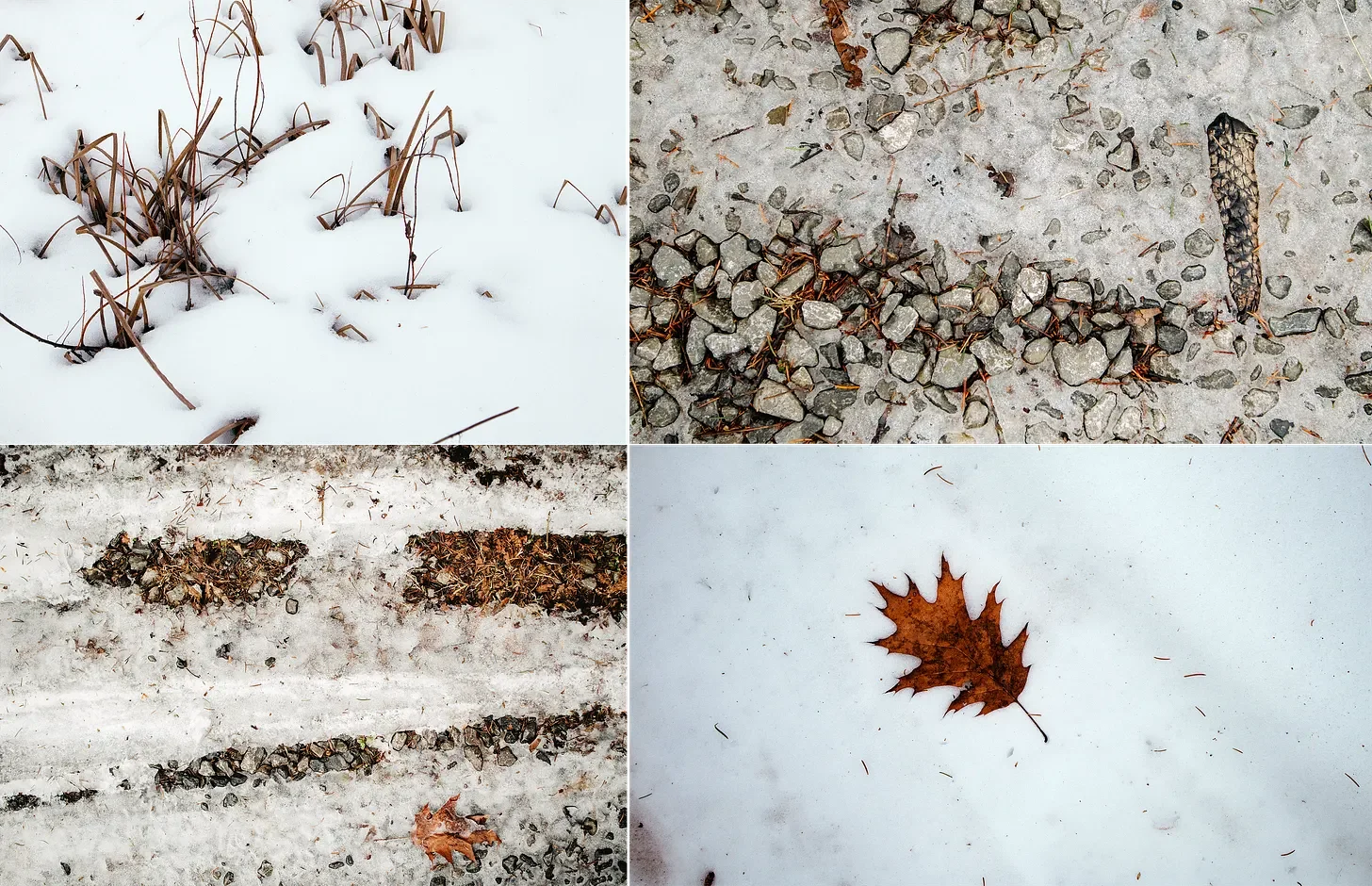
After weeks and weeks of being frozen in place under a blanket of snow, the sight of grass is once again emerging. Winter is far from over, but we’re ready to seize this fresh start, however brief it ends up being.
This is after January’s unexpected pause on harvesting, which became a happy circumstance, and ultimately softened our starting outlook of needing to adhere to a strict winter schedule.
At the start of the new year, though, we were worried.
It was frustrating to stare at the rows upon rows of frozen plants that need to be leveled in preparation for all of the workshops we’ll be teaching later this year, which put us face to face with the need for flexibility.
With the pressure to pivot, we seized the opportunity to focus on other projects.

A peek inside an old creel, getting updated with new white willow
I hunkered down on the couch, with our extremely elderly Border Terrier, Baron, by my side, and worked on aggregating data and newly captured media for our upcoming cuttings shop, as well as a variety of personal projects for a couple writing and illustration classes I’m currently taking.
Out in Dan’s studio, he spent at least half of January bending frames for our upcoming classes, but also got into a groove of weaving new work from 2024’s leftover material.
He even played with creating white willow by stripping rods of their bark, and then split them in half in order to weave them within a preexisting creel (above).
The leftover bark was braided into a sort of cordage, just for fun (below).

Strands of stripped willow bark, and those strands braided
In the unexpected spaciousness of the past 5 weeks, ample room opened up for more philosophical discussions about life, business, and future plans. Looking back, there was a definite tidal shift about 3/4 of the way through the month, when our anxieties gave way to ease and excitement.
Now that we’re tucked into these cozy, imaginative days, however, the changing weather has reopened the possibility of harvesting. Just when we were enjoying a more hibernation-level rhythm, it’s time to re-route our attention back to the fields.

A bird’s eye view of a backpack in progress
At the end of last year, we had an aspirational flow for each month mapped out:
Harvest from December until March
Establish new plantings in April
Teach from May - August
Work on personal weaving from September - November
Now that we’ve started a whole new year off-kilter, we’re realizing how silly it was to tether such a tight schedule to the whims of the weather.
Moving forward, we’ll keep this general blueprint, but with a much looser grip on the need to execute it exactly. The need for a more inward, reset month, like the one we just had, feels paramount - and was noticeably missing from our plans.
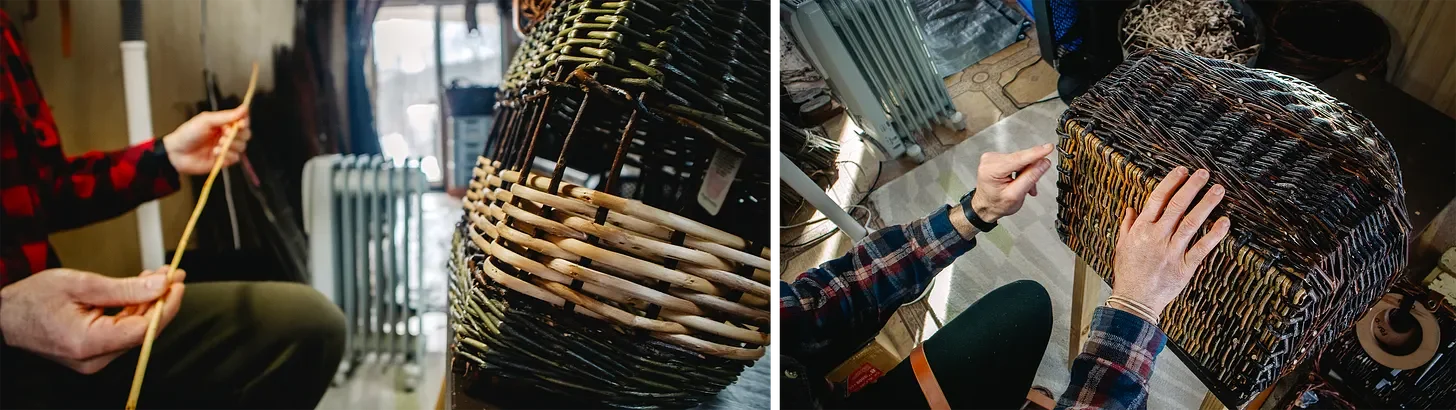
Adding white willow to a creel, and inspecting the base of a new backpack shape
As February arrives with the first (nearly) fully thawed out week we’ve seen in a while, we’ll be starting from scratch when it comes to harvesting, and aiming for the best when it comes to maintaining a productive pace.
Whatever conditions arise, January has certainly primed us to better go with the flow.

February 1st, finally back in the field
Originally published on February 2, 2025
Nibbling Away
We’ve officially been pulled out of January’s unexpected reverie.
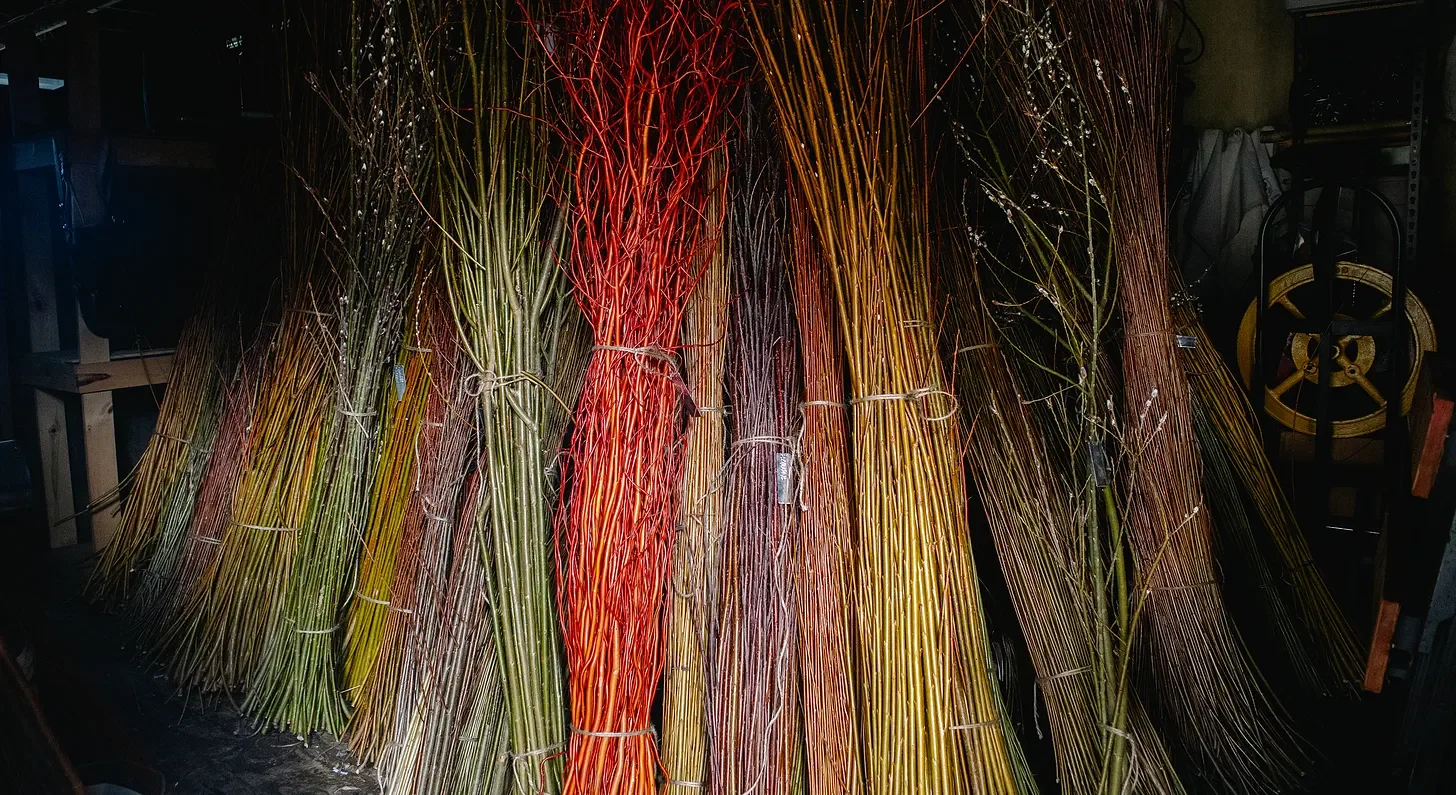
With the snow finally gone,* Dan spent as many hours as he could cutting rods and creating bundles this week, all of which still need to be sorted, and processed.
Our only building, a generously sized shed, is already approaching max capacity.

Having such scarce square footage becomes an increasingly bigger problem each harvest season, but thankfully willow has been flexible enough to fit.
After looking at nothing but blinding white for so long, it’s been a jolt to the eyes to be amongst the fieriness in the field. Years in, the vibrancy still astounds us.
Also jolting was the discovery of the voraciousness of our rabbit residents, who decimated nearly the entirety of one row.

Chewing and chewing and chewing
It’s a blow to lose so much material to the maddeningly infinite maintenance of rabbit’s teeth, but it’s been a rough winter for the critters around here, and we like to think there’s more than enough to go around.
Elsewhere, we discovered a bit of what the voles have been up to.

These are the discarded trimmings from our fig trees, which we were happier to see being utilized for the dental demands of our other most pesky population. Who knows what else they’re up to with their never-ending nibbling, beyond the bounds of our sight.
In contrast, birds have been the most amusing inhabitants of the week, noisily and ecstatically exploring what the newly liberated ground has to offer. Finally, with foraging powers restored, the suet we put out sits quiet.
Lilting screams of two hawks circling each other turned our auditory attention upward all week, reminding us to tap into every sense that’s been shut away.

One afternoon Dan spotted a hawk out the window on his way out the door, where it sat scrutinizing the landscape atop one of the perches we’d put in the field. Not wanting to interrupt the hunt, he decided to watch and wait. After a few minutes the hawk swooped down and caught something, perhaps a vole. Sustenance secured.
We all need help seizing the opportunities of the day.

Paw Paw, Sea Kale, Daffodil, Hellebore
Paw Paw flowers have already appeared, little brownish buds with fuzzy promise. Our trees haven’t yielded any fruit yet, but perhaps 2025 is the year. With less than 40 days of winter left, Sea Kale, Daffodils and Hellebore are also starting to stir.
All these levels of awakening compete with the urgent tasks at hand, splicing our attention between noticing, and needing to get things done.

Another bundle, separated from its stool

I’m at the tail end of another Botanical Illustration courses at Phipps, a hobby that serves as a channel for unwinding anxiety. Beyond the paper sits my piano, where I try to stoke the fires of robust cognitive function by way of my rusty fingers, reminding myself that dust can’t settle on a daily practice.
There are so many layers of tending to a life.

When a row has been harvested, the leaves left behind get raked up and redistributed. This year our garlic will benefit from the nutrient rich soil they’ll break down into.
In a perfect world we wouldn’t have to use landscape fabric, and the willow could enjoy the entirety of its own life cycle. We’ll get there some day, but for now it’s a helpful tool in achieving the abundance that has allowed our business to grow.
At the end of each day, forward momentum is the only reliable metric.

*The snow hasn’t disappeared entirely, and there’s more in the current forecast, but I’ve enjoyed watching the shapes and lines that have stuck around - especially curvy ones like this.
Originally published on February 9, 2025
The Life Cycle
growing up to be cut down

We grow willow so that we can cut it down.
It likes it that way - seizing the opportunity to rise yet again each spring, almost always succeeding better than the year before because of it.
And even after being cut, dried, re-hydrated, and woven, it rises to the challenge of embodying a second, practical life. The ultimate shapeshifter.
We have grown alongside this perennial powerhouse for more than half a decade now, finding inspiration, and an anchor, along the way.

Each stool that remains after having its rods sheared off serves as a living memory of all the years it’s held. Like a potato boundlessly sprouting eyes, what remains will take the message of our enforced emptiness as a sign to work abundantly harder.
As new rods squeeze forth alongside swells from which life has already sprung, the whole form will widen to accommodate the growth of old and young, side by side.

Our thousands of willow plants range in age from 1 to 6 years old across the acreage, all with incalculable lineages expressed before they landed here. And the many rods we’ve sold, traded, or donated have gone on new adventures all across the country, where they stretch into new roots below, to support new cycles above.
With a primary objective to grow, the more opportunities for willow, the merrier.

After we cut and capture a season’s worth of growth - a process we’re still in the midst of now - our objective is to usher the yield from a feral state, to one that’s more finessed.
Once they leave the field, rods traverse state changes over the course of months, ultimately making them fit for craft. This final form, shaped by our heavy handed intervention, is far from mass-produced, reliably consistent products, making it a medium that is both frustratingly demanding, and satisfyingly unique.

Bare stools mean our tools are often in need of sharpening.
Weaving requires a tactile scrutiny of the material at every turn, and balancing the minutiae of individuality can verge on exasperating. Dan becomes a broken record in classes, repeating the mantra: basketry is about symmetry - which is an aesthetic and structural goal that willow fights against with fierce irregularity.
To be basketmaker, you must meet willow’s strength with your own.
Once tamed into a basket, however, each rod’s personality is held, forever floating, in sturdy suspension. The fact that this plant can endure such a medley of manipulation after such a brief life, and still retain its wild beauty, is endlessly fascinating.

The massive compost heap, where misfit baskets go for their next adventure.
Willow rewards subtraction with abundance, inspiring you to take from it, and challenge it, so that it can give you more. As simple and repetitive as this life cycle is, it’s the reciprocal possibilities that keep us going round and round with it.
We grow willow so that we can cut it down - knowing that in doing so, our relationship with it will continue to grow.

Every empty stool = a basket manifesting somewhere in the future.
Originally published on February 16, 2025
Gray Area

What truths can you trust within yourself?
The reassuring clarity that seems to come from time, space, or shock?
The heat of the moment reactions that turn things black and white, all or nothing?
The gray area that engulfs you in the fogginess of infinite possibility?

We seem to float between all of these states, assured by the certainty of each as we experience them, especially the ones that feel like the firmest convictions.
Perhaps the gray area is the only one that truly holds the genuine fact that nothing is ever actually defined.
Feelings, knowledge, and direction are all malleable in every moment.
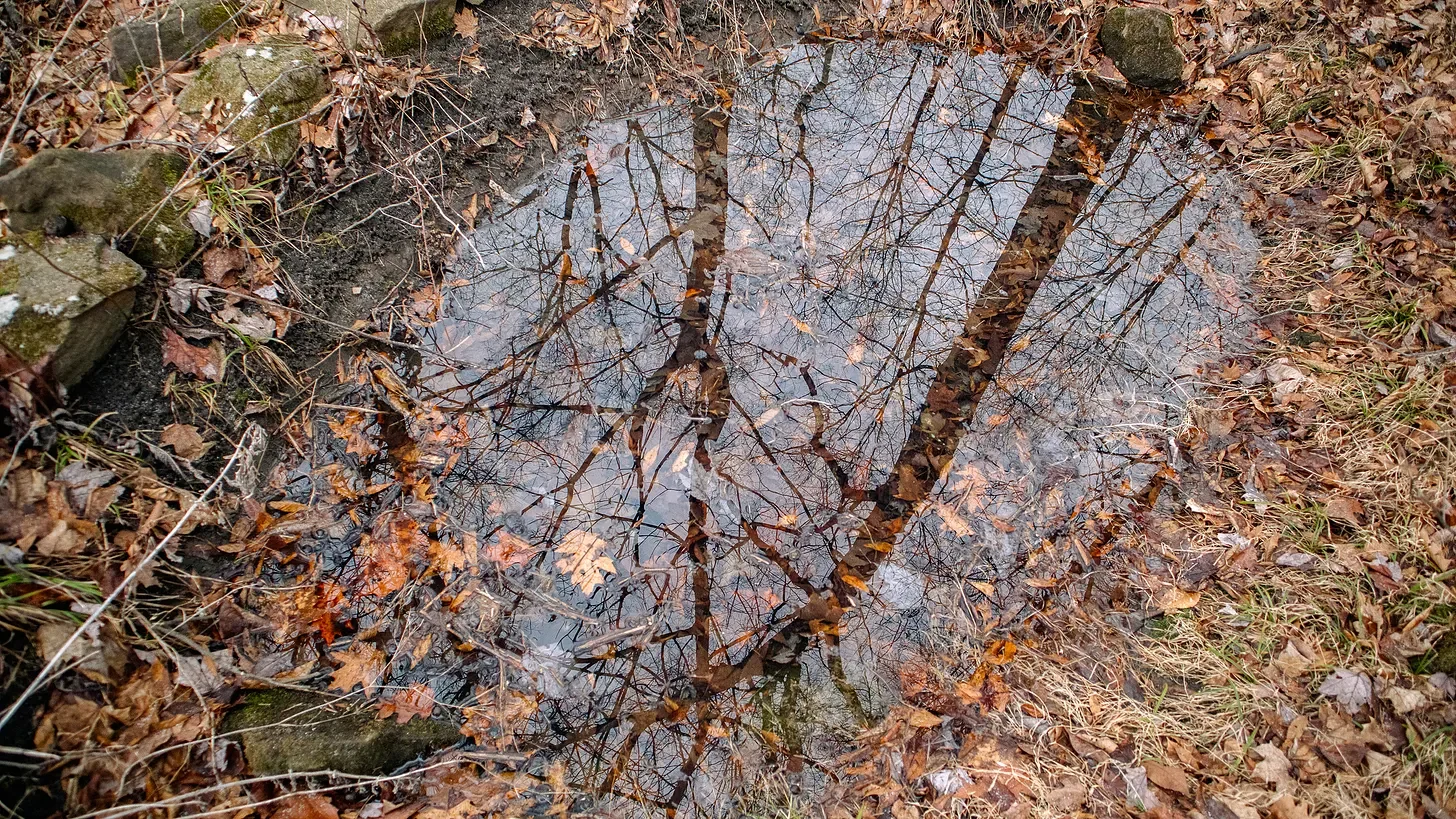
In these off months, with quiet space to spare, we waiver between wanting to pursue opportunities, or retreat from them entirely. We forget the worst parts of what we’ve experienced, or only focus on the lows.
The past can easily be rewritten, depending on how you want to stew in it, or launch away from it. The possibilities of the future are colored by all of this, making for a murky sense of direction as we move towards it.
One has to make choices, though, knowing intention is the only anchor in the fog.

I suppose these thoughts are a combination of reflection and resolution - aftershocks following the arrival of a new year, which always puts the one before it into sharp focus. A pause at the threshold to fully take stock feels necessary, but fleeting.
Thankfully, we have taken enough action for enough years now to swim in a data pool of deep experience, but temptation lies there to do more of the same.
Plateaus provide a solace to settle into, but itchiness arises quickly.

Perhaps willow, the foremost expert in elasticity, has literally infiltrated the conversations that have inspired these musings. The past few weeks have been spent in direct contact with thousands of rods, which have been harvested, and then diligently processed, one by one, into future weaving material.
The shape of how all this winter work will ultimately manifest is hazy, as we wait and see which workshops will fill up, and which may face the chopping block.

This notoriously gray season is likely also contributing to thoughts of life’s gray areas, where every possibility can exercise a passing sense of solidity.
Maybe the question isn’t which truths you can trust, but rather which ones conjure the most authentic resonance upon arrival. That internal compass, when we can clearly access it, has always ushered us towards the right next step.
From intuitive indistinctness, direction inevitably emerges.