
Sprung
nettle, ramps and blossoms abound

Nanking Cherry Blossoms
Silky pink and white petals have begun to shimmer across the acreage, signaling that spring has certainly sprung.
There was also a bouquet of hellebores brought in to jazz up our dining table, ramps added to my cooking, and daily stinging nettle infusions drank.
Once those prickly nettle leaves begin to stretch across the surface of the soil, I pluck handfuls of their not-yet-too-painful-to-touch stems. Each day they grow taller and spikier, but steeping their young growth in hot water yields a celadon colored tonic that safely strengthens us too. Spring in a glass.
We try to get as much of it as we can, feeling the palpable anti-inflammatory effects.

Top left, clockwise: Nanking Cherry Blossoms, Honeyberry, Daffodils, Stinging Nettle
April’s arrival put a somewhat tidy bookend on this season’s willow harvest, which began back in December, and was equal parts slog, and satisfaction. There’s still sorting to do in the shed, but with a few beautiful days, Dan turned to other tasks.
Continued grafting projects were the biggest undertaking, which built upon work we’ve been doing for years across our fruit trees.
Grafting is simply taking a cutting (scion) from one tree, and adding it onto an existing tree (rootstock), by joining tapered pieces together. Eventually they become one.

A successful graft from a hometown crab apple tree that has grown into a beautiful branch, and a brand new, freshly applied graft on an apple tree
The technique Dan’s done the most is whip and tongue, the idea of which is not far from the interlocking tongue and groove shape within woodworking. This builds new branches, which are sometimes then trained by tethering them in specific positions in the pursuit of a particular shape.
It took several days to get to all the fruit trees that have new scion wood ready for them, and this work is the epitome of a long-term investment. If successful, mature apples, pears, plums, and more will come in 5 to 7 years.
The hope of a personal relationship with each variety sits somewhere in the future.

Parafilm Tape + a spray of Treekote prevent desiccation & gives new grafts a shiny look
Some day these singular trees will feature entire collections of varieties across their branches, but for now the focus is to continue topworking, which is stacking new varieties onto as many scaffolds as their structure will allow.

Five years ago, we began cultivating ramps (wild edibles in the onion family) within boxes at the wood’s edge, which were open on the bottom, and covered with mesh screens on top. Dan learned of this protected approach from an article, which framed it as a more fail-safe way to get ramps going.
After years of establishing them in this micro-nursery at the woods edge, we decided it was time to move them to our main nursery, where they can continue to mature. Incredibly robust and beautiful roots were evidence of the box technique’s success.

There are quite a few clumps of ramps already growing very well throughout the nursery, which we procured from a forager at a Pittsburgh farmer’s market years ago.
While they’re young, we abide by a personal rule to only take one leaf from a cluster of three, for personal use. The thinking is that this will ensure their ability to grow as healthily as possible, which will hopefully yield robust edible bulbs below ground, in addition to the leaves above.

Ramps in the nursery, ramp growing “wild” in the woods
Just days ago, we discovered sporadic ramps growing in our woods, just beyond the boxes at the edge. This was a surprising sight, but was the result of our own hands.
In 2020 we also planted ramps throughout those woods, but had deemed them a failure after years of inactivity. It turns out they were just on their own timeline.

Best guess is that this fungi is from the genus exidia
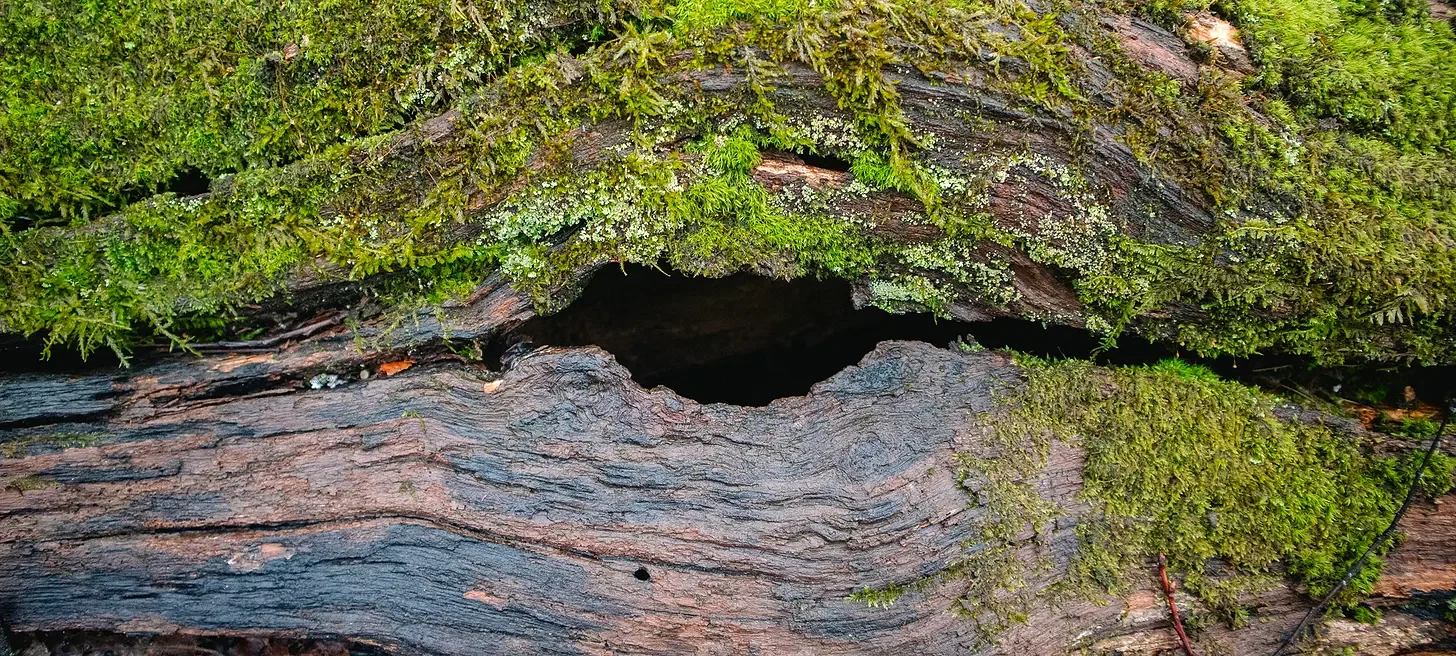
I’ve been visiting the woods more often in hopes of finding the first morels, or a honeybee swarm, but so far I’ve only discovered those surprise ramps, and this somewhat ghastly looking mushroom on a rotting log. There’s always fascinations to be found in our micro-forest, and it’s my favorite place to be this time of year.
Out there I’m reminded of when we first arrived here, and springs were spent scouring the corners for wild signs of life, as our cultivated areas were too young to yield anything of note. Back then we found patches of daffodils springing up, and spring ephemerals we didn’t yet have names for.
Now we know coltsfoot, trillium, bloodroot, trout lily, may-apples, and so many more.

Spring is the epitome of manifestation, as everything coming to fruition at this moment was set in motion long ago. Nothing sprouts to life without an origin story, and with the work we’re doing now, there’s much to look forward to on a faraway day.
It has been a rather wet spring so far, yielding rich greens, especially across the mosses. We hooked up the rain barrels just in time for a few intense days of downpour, but there is cold in the forecast.
All that has sprung will be put to the survival test, and what persists to see the sun again will be even stronger, and more spectacular.
Originally published on April 6, 2025
Fresh Intention
radiance returns

Snow + sun in the nursery
Spring is solidifying.
Our new seasonal routines are settling into place too, with longer, sunnier days serving as our guide. April feels like a far more realistic version of January, with the wherewithal and energy to support freshly ambitious endeavors.
We’re all awake, and getting to work.

The willow is wasting no time shapeshifting, already springing back to life after being leveled. Stools in varying stages of maturity are sprouting, racing to get back to robustness. The negative space our harvest created will be fleshed out in no time.
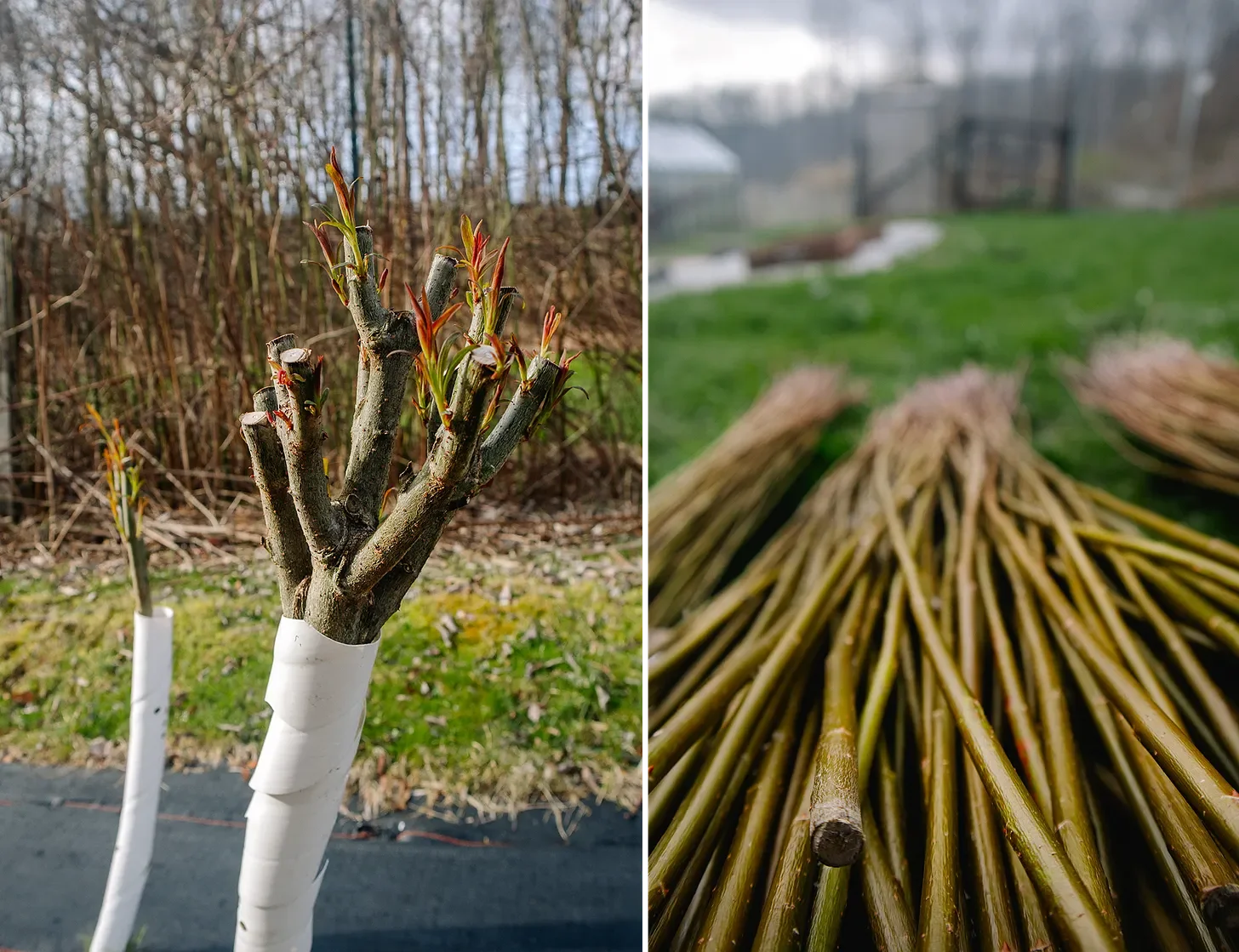
Willow - Sprouting, and being sorted
The hellebores, with their perpetually drowsy heads, are holding on, and shyly offering their splendor. Cherry blossoms have all but floated away, clearing the stage for apples, pears and plums to burst open.

Hellebores above, cherry blossoms below
The major task this past week was cleanup in the nursery. That fenced in, generously sized plot was once the primary project on the farm, but has been put on the back burner in recent years as our focus turned to willow.

Rows have become overgrown, with vines and canes having their way with the space. After many tedious hours spent clearing, it has been satisfying to see walkways again for the first time in years. For a few precious weeks, we’ll be able to see clear lines before growth fills them in.

It was a rather wet week, with notoriously damp spaces pulsing nonstop. It doesn’t take much precipitation to put the daffodils down on their sides, which together become a gloriously ombre’d tangle of green.
Unfortunately, it has also been a rather cold week, which has all the blossoms on neighborhood Magnolia trees looking like wilted wisps of brown paper bags.

Top left, clockwise - Coltsfoot, Daffodils, Lupine, Wood Ear Mushrooms
The saturation of the earth is no doubt giving roots and mycellium replenishing energy in spades, the results of which will be on display soon. As we squish our way across the acreage, we’re looking forward to seeing all that the moisture will yield.
There is already a luminescence from the intermingling shades of green, which are glowing from the excess drenching.

Daffodil above, garlic below
Also springing back to life are the animal populations. A parade of deer pass by our windows daily, nibbling away at the revitalized fringes of the woods.
Turkeys sweep through too, with toms spinning to show off their tails like fanning stacks of cards.

Any twiddling of thumbs that may have lingered after winter have been traded for clear ticking off of tasks. Spring cleanup will soon give way to new initiatives, as we set our sights on seed starting projects, expanded willow plantings, and the establishment of Foggy Blossom’s first roses.

Trimming the Azalea tree
We’re all awake, and excited to cultivate fresh intentions.
Originally published on April 13, 2025
My Favorite Fallen Tree

April 2025
When we moved here 8 years ago, I fell in love with this big fallen tree.
I know nothing of its life, or the story of why it fell, only that I was drawn to it from day one. Being 32 years young, I unflinchingly ambled across it regularly, learning every groove and gradient. It’s high enough off the ground to feel a bit thrilled when you’re on top of it, but wide enough to still feel secure.
A year after landing here, I decided to embark on a springtime Stand-Up Paddle Board Yoga training program. I’d been teaching yoga for a while and felt strong, but I employed this tree (and every other one around) as wild balance beams in preparation for getting on the water. I didn’t want to look foolish, falling off my board constantly, so I stumbled in the privacy of our own property as I built up my strength.
Thanks to the trees, I completed the training with confidence.

October 2019
The following year, I was compelled to make several series of conceptual photos, including the one above of me on the tree, on the phone. It’s not a setup I found ultimately successful, but I’m glad to have this unique documentation of our bond.
These days I’m creatively compelled in other directions, and sadly, my favorite tree has begun to rapidly rot. With every crumble I become less surefooted on top of it, and nostalgic for the freshness of its strength (and my own) back in 2017.

Robin nesting in the Azalea tree
All across the acreage, birds are building their own structures to support their next adventures, and the brawny power of last year’s vines are on full display.

We’re still harvesting young stinging nettle, which is another being that predates our presence here, just like the trees.


A nest of eggs, cradled deep within a patch of nettle
In the beginning we often used the term rewilding to describe our mission, aiming to respect and nurture the natural character alongside our more self-serving cultivations.

There is plenty of flashy color to pull the eye at the moment, most of which is growing because we planted it, but it’s the more subtle anchors that stretch before and beyond us that offer a glimpse at the greater scope of this land’s life.

Daffodils and blueberry blossoms
The farther we get from day one, the more striking our efforts to reshape this place appear. Our bodies have aged in tandem with the acreage, but the long established edges remain relatively the same.

The nursery - 2018 vs. 2025
The woods that frame most of this place are full of fallen trees, fungi, bones, and more. That wildness outlines the lines of our life, within which we continue to scribble, finding security in the assuredness of every cycle that will outlive us.

Dan delivering a bundle of “scrap” to its final resting place in the woods
The sum of every part of this place is a veritable playground, rewilding us most of all.
Originally published on April 20, 2025
A Bunch of Beauty
let’s glow

The shed has become a dark cave of chaos.
Bundles of willow are stacked or standing in every available space, with box fans high and low to help dry them out. Ties and tags sway in the breeze, with many still awaiting their final sorting. It’s a tight squeeze, and far from an ideal place to hang.
Outside, it’s a different story.

Pollarded willow springing back to life
Despite the discomfort of midsummer temperatures here at the end of April, it’s hard to ignore the beauty the warmth brought on.
We can’t get enough.

Pear blossoms, asparagus, dandelion heads, apple blossoms, trillium
We are finally getting great yields of asparagus, and the abundance of apple, pear and plum blossoms are exciting signs of potential fruit harvests in our future.

Hakuro Nashiki coming back, new cuttings going in
The willow stools have also burst back to life, seemingly overnight, and cuttings have been plunged into the ground in new growing spaces. Dan used a tool called a sewing palm to ease the repetitive motion of using his hand to push them in, over and over.

Akebia, grape, daffodils, Laceleaf Maple
After a rather cold and snowy winter the radiance is refreshing, albeit staggering.

Dan pulling buds off the pollards
Under the glowing sunshine, Dan worked to remove internal growth from branches on pollarded willow to better build their permanent structures. In other words, he rubbed off new buds by hand.

Paw paw flowers starting to open
It is always a joy to see paw paw flowers returning, and while we haven’t yet seen any fully formed fruit on our 6 year old trees, there is hope again this year. Fingers crossed.

Blueberry blossoms, asparagus, snail, trillium
A snail interrupted one of our morning walks, serving as an enchanting reminder to slow down. There is so much to soak in, amidst all there is to get done.

A first try at a living fence
After years of saying we’d love to giving living willow work a try, we’ve finally made it happen in the shape of this experimental fence. We didn’t have quite enough large/long material to make this as intricate or dense as we’d like, but it’s a start.

Baron
Sometimes it’s the things you don’t want to face (looking at you, overstuffed shed), that puts the most beautiful things right on your path.