
Powerless
after another storm

For the past 4 days we’ve lived alongside the nonstop humming of our generator.
Another brutal storm swept through this past Tuesday, inflicting an immense amount of damage on nearby Pittsburgh. Thankfully, our area was left largely unscathed, but we did lose power, and have been low on the list to get it back.
Our generator has been doing a good job of keeping most needs met, and fortunately the post-storm weather has been beautiful, pulling us outside in search of peace.

Tulip
We passed the midway point between spring and summer just after the storm, and May Day also marked the first formation of many fruits.

Currants
Dozens of Currants shrubs are covered in green globes, which will soon ripen into an abundance of champagne, pink, red and black hues.

Nanking Cherries
Nanking Cherries, which we haven’t yet enjoyed a yield from - they all froze and fell off last year - already have early, hopeful shapes with rose-colored ambition.

Ladybug in Hazelnut leaves
Insect populations are becoming more plentiful all around, and a first hummingbird sighting prompted us to happily fill our feeders and return them to their usual spots.

Tree Peony in bloom
Several of our Paw Paw trees have sadly succumbed to a boring bug (granulate ambrosia beetle), but there’s still a few standing strong. They’re another fruit we haven’t yet seen reach full maturity, but every crimson bloom that peels open has us feeling optimistic.

Paw Paw blossom
Fears of sub-freezing temperatures have been laid to rest as the forecast continually improves, so it feels safe to say that everything taking shape right now has a good chance of survival moving forward.
Fingers crossed.

Asian Pears
There’s no telling what lies ahead in terms of weather - which this year has already showed us in spades - but these glimpses of beauty have kept our spirits buoyant.
As our power situation hangs in the balance, it feels imperative to gravitate towards every available source of brightness.

Blueberry blossoms
The silence that will return after the generator finally finishes its work* can’t come soon enough. Until then, we’re grateful for the many sources of tranquility that exist beyond the power grid.

Blueberries starting to form
*The power (and peace & quiet) returned around 5:30 pm last night.

P.S. We are also currently enchanted by the first fox that has found a home at Foggy Blossom!
Originally published on May 4, 2025
Surface Tension
time to strip, scrape, score, peel
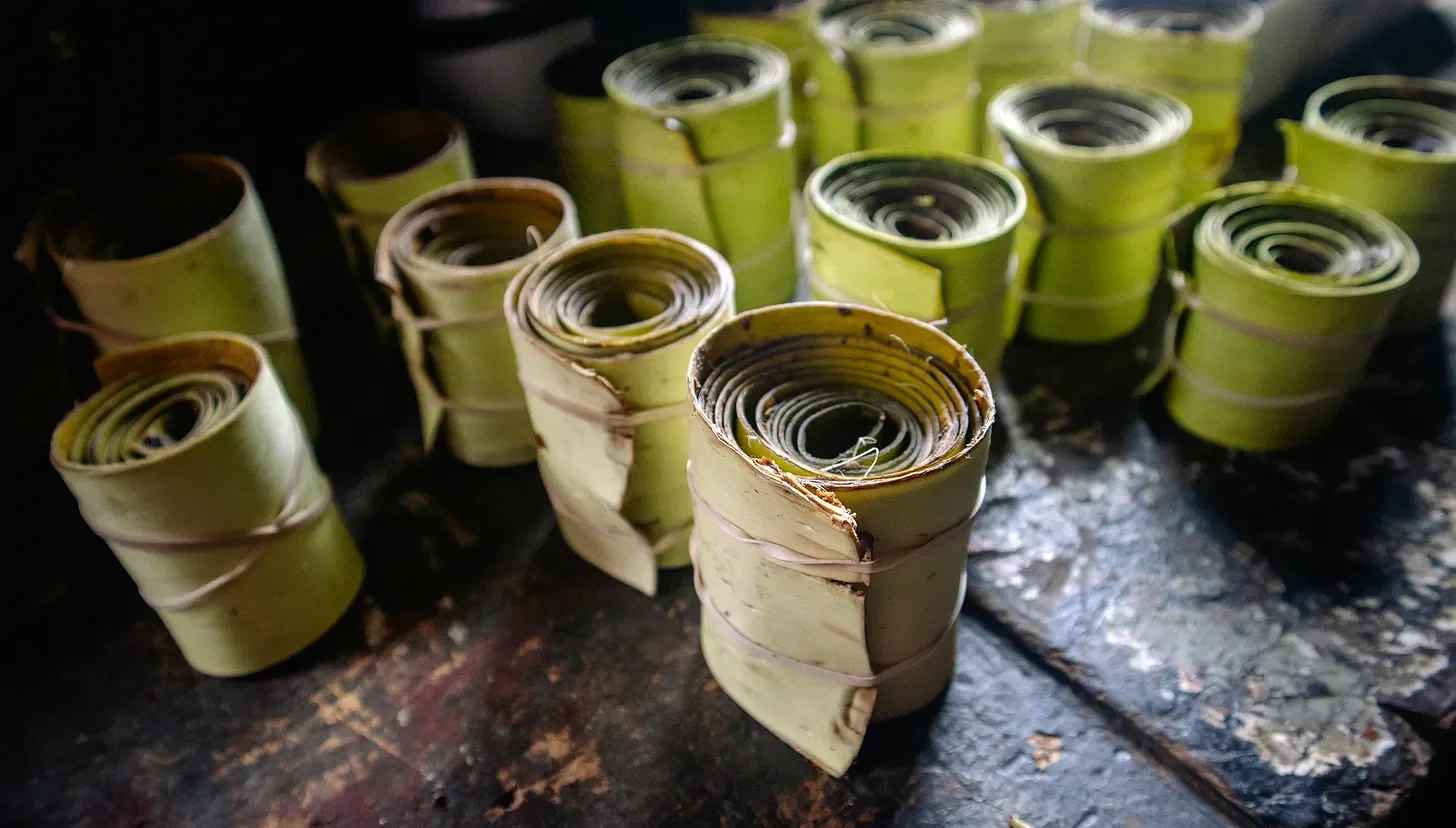
Rolls of willow bark
Water has been wiggling its way up, down, and all around.
From heavy rains to opaque fog, there’s no shortage of moisture moving about, saturating every inch of the acreage this spring. The connection between the bark and core of trees reawakens this time of year as life, built from within, pushes outward.
Imperceptible space between the skin and the skeleton allows this force to move, and creates opportunities for both heavy handed manipulation, and delicate separation.

stripping buds off of pollarded willow
When it comes to willow in the ground, buds have been hand-stripped in specific areas in order to send their energy elsewhere. Reshaping via surface manipulation.
Around the shed, harvested willow that has been sitting in water are showing signs of readiness to have their bark stripped away - either through aggressive scraping, or by carefully peeling it off by hand in one, complete piece.
On rainy days, this has been an ideal activity.

Peeling the bark off a variety called Jaune de Falaise
When leaves appear on the branches, it’s an indication of the activity happening within, and the willingness of the willow to be peeled. A score with a knife along the entire length of the rod perforates the attachment between bark and core, allowing for a careful relieving of their bond.
Dan describes the slow and methodical process of peeling as very satisfying. The highly tactile severing feels cold and smooth on the fingers, almost like the flora equivalent of skinning fauna.

Once the husk has been released from its host, it takes all the life force with it. The highly pliable ribbon is rolled up and set aside to dry, while the inner core becomes a rod of white willow.
One being becomes two materials, both of which can be woven in distinct ways.
We haven’t allocated much willow over the years to create a proper cache of peeled bark from, but this year Dan stashed away the biggest yield yet for this purpose. Time will tell what these rolls ultimately become.

Mushy soil is primed for planting, and on a clear day last week we received an order of 24 rose bushes across 11 different varieties.
Of all the perennial flowers we’ve established here, roses were never top of mind.
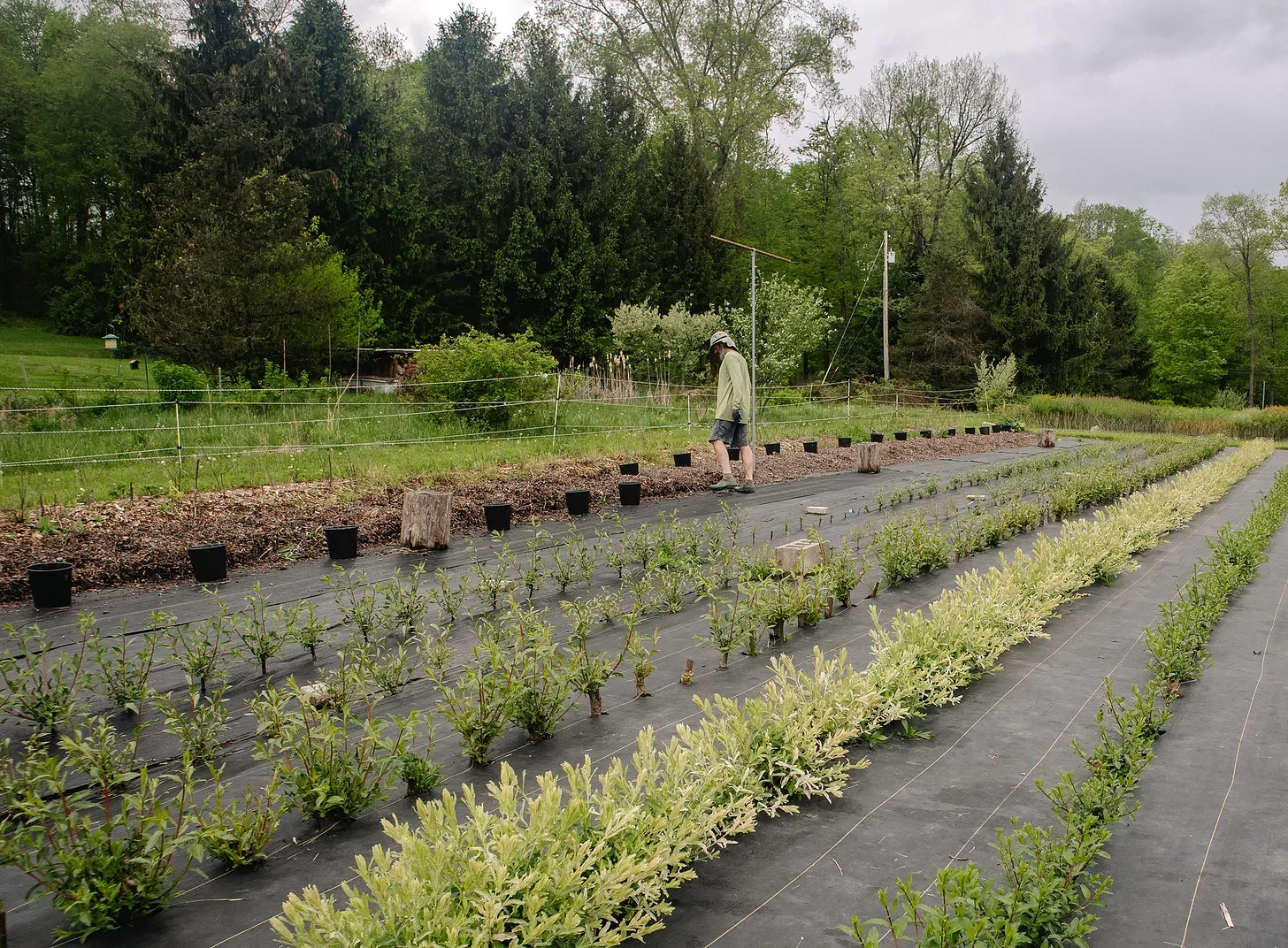
Putting the rose bushes in alongside some willow
In 2018 we took Floret’s first Flower Farming Workshop, and have followed their work with great admiration ever since. I credit an episode from Season 2 of their show, Growing Floret, which centered around roses, as inspiration.
We’re looking forward to the future blooms that will join our population of peonies, hydrangeas, lilacs, and many more.

Top left, clockwise: Dan & Baron, Tree Fog, Swallowtail Butterfly, Tulip
Despite the drenched lushness, some life has been slow to spring back.
We’re still waiting on Irises and Lupines to pop their purple tones, bird’s nests full of eggs are few and far between, and more pollinator sightings would certainly be welcome. One group that has returned in particularly noisy numbers, however, is the Gray Tree Frog.

Gray Tree Frog hanging out in a Paw Paw tree
Their sound can be all encompassing when they really start singing, and despite my assumption that I’d never be able to spot their well camouflaged forms, I happily found a handful of these cute little friends hanging out around the nursery.

As we pull farther away from the frozen days towards the direction of the sun, the signature swampy curtain of morning fog becomes the norm.
On those days the farm feels like its being held in a fishbowl of moisture, with water penetrating every inch from soil to sky.

A peony bud glowing in the fog
You’d think the thousands of willow plants growing across the acreage would gulp up a good amount of water through their thirsty roots, but Foggy Blossom could easily be renamed Soggy Blossom, thanks to the perpetually wet personality of this place.

With all the surface tension building, we can only be grateful for the forces that will springboard against it to sweep another season of abundant life through this land.
Originally published on May 11, 2025
Opportunity to Observe
from sepia to sparkling

Top left, clockwise: Peony, Iris, Azalea, Strawberry
When I began editing this week, I wondered if something had somehow changed within my camera settings.
The photos looked suspiciously and supernaturally luminous, but I couldn’t deny that real life has been appearing that way too. Perhaps the excessive saturation from this season’s many rains is responsible for the vibrancy, or maybe I’ve just forgotten how radiant spring can be.
Whatever the case, at the risk of sounding hyperbolic, it’s as if the sepia veil has been lifted, revealing our own version of Oz.

May is the final month where we can wander through the willow fields and still stand taller than the new growth. In some areas it’s already chest high, and in others the rods are leafing out around the ankles.
Pretty soon, though, a stroll through any row will completely swallow us up.

A nest of Red-winged Blackbird eggs
I recently mentioned that we’re short on bird’s nests, but just after asserting so, Dan found this one crafted by Red-winged Blackbirds. The quartet of pale blue eggs are streaked with inky, abstract marks, and the parents are vocally protective when we’re in the vicinity.
I snapped as quickly as I could and moved along.

Kousa Dogwood blossoms
At the edge of the woods, where the Dogwood blossoms delicately danced in the shadows, I was able to linger, and properly soak in the sights. Beside the pond, I had to practice lurking with patient stillness to capture a frog.
There’s no shortage of opportunities to practice observing in new ways.

Frog in the pond
2025 is on pace to be overflowing with fruits, many of which we haven’t yet seen reach full, edible completion. In these early stages of formation, it’s tempting to time travel forward, and imagine the taste of our first homegrown peach, the forthcoming hues of the mulberries, or the picking of dozens of apples.
It is a very optimistic time, and all hopes are supported by these early, sparkling sights.

Fruits forming: Peaches, Mulberries

Highbush Cranberry blossoms
Ironically, my creative pursuits this past week have been entirely desaturated. I’m in my second year of working towards a Botanical Illustration Certification, and this latest assignment was to illustrate roots in graphite.
As someone who gravitates towards creating with as much color as possible, any work that’s done purely with pencil tends to bristle my feathers.

I’m always happy with the results, however, and all grayscale practice undeniably supports future creations that include the full rainbow spectrum.
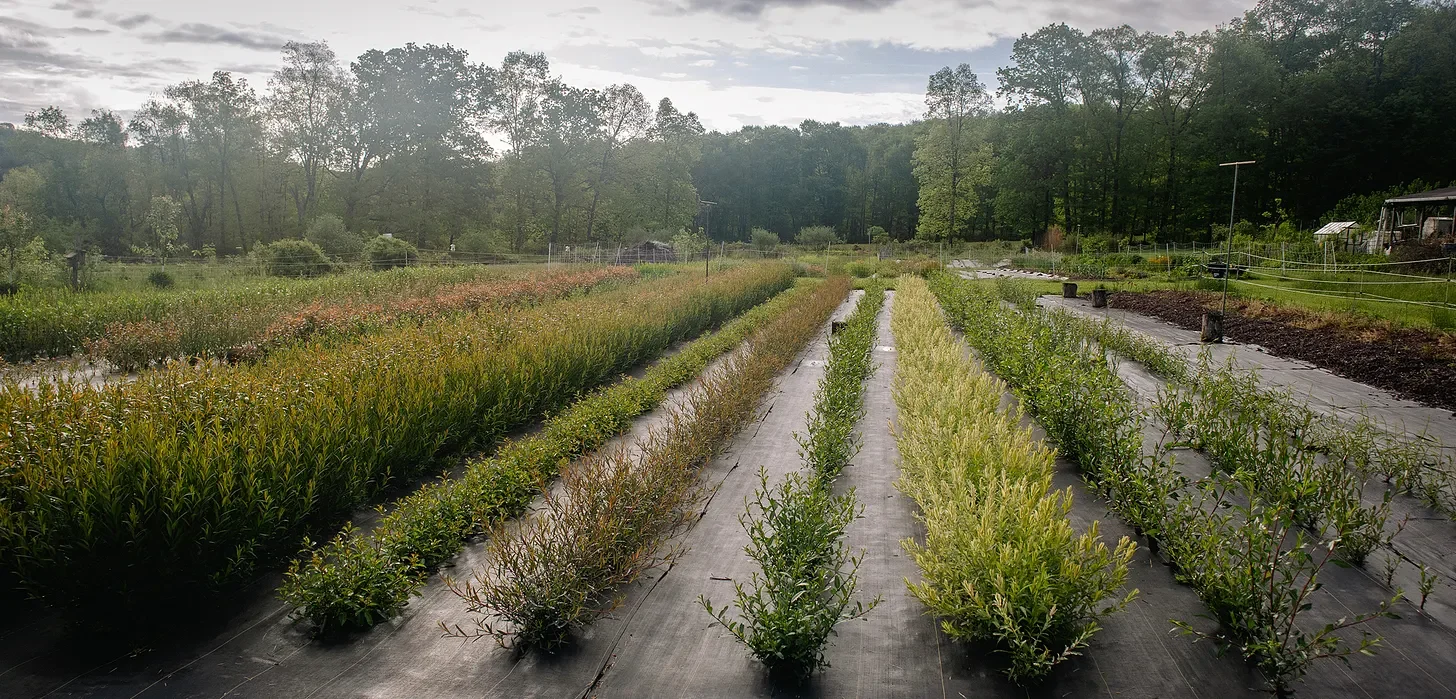
Spring willow bouncing back
With just one final month of spring left, I know this clarity of sight out in the fields, and in the nursery, is on a countdown clock.
Clear rows of willow will become one bushy, indiscernible clump, and hopefully there will be so much ripening fruit that we’ll forget all hyperfixations on particularly promising branches.
Bird’s nests will be even harder to find amidst the lushness, but maybe we’ll catch a few fledglings take their first flight before then.

Apples forming on a branch, and a surprise nest of babies below the tree
Home is as glittering as ever, and there’s no place like it.
Originally published on May 18, 2025
Polarity Therapy
summing up the past 6 months

Peonies
Harvesting and planting are done, and for the first time in a while, the soaking tank is full of dried willow, drinking up water in preparation for our first workshop of the year next month.
Flannel sheets have been put away until fall, berries have begun to ripen, and in the flower field the peonies have popped, all thanks to a handful of days that sweltered like the height of summer.
Temperatures have dropped into the 40s and 50s this week, though, slowing maturity and making me question the premature coolness of cotton at night.

Tiny spider in a bunch of blueberries
This month has been an exercise in springing forward and falling back, which has already been a trend for much of our 2025.

2024 ended in transition.
Following the exhaustion of an overloaded year with willow, we laid to rest one of our dogs, and I was on the receiving end of a car accident - totaling our vehicle, and fraying my final nerves - all in the same week last November.
Having already committed to an ambitious schedule of teaching for 2025 at that point, we wondered how we could manage it all as life began to shift.

First peaches taking shape
That was before we settled into a new normal with our remaining dog (whose advanced age is an increasing challenge), before we were hit with a violent hailstorm that inflicted damage across our home and new vehicle (which is all still waiting to be fully fixed), before we lost power for 4 days from another storm, and before the unexpected care taking of a family member far from home.

Strawberries, Peonies, Hardy Kiwi blossom
I write about all these experiences from a seat of optimism, as they’re well beyond the first stages of urgency, but repercussions are still palpable in the present.
Due to all of these circumstances, we ended up scaling back our teaching obligations for the year ahead, and in this unexpectedly more home-bound moment, we’re enjoying the opportunity to be engulfed by our environment.

Goumi ripening
Last year we were on the road/teaching so much that we became disconnected from the nuanced dimension of every day, leaving lots of plants to fend for themselves.
An overwhelming amount of cleanup work awaited us this spring, and with restored, abundant access to the acreage, we’ve returned to our role as nuisances among the fray, noticing every shift in excruciating detail.

Rows of willow coming up
The plants probably prefer their wild days when I wasn’t shoving a lens in their face. But as I diligently document the rising willow making waves across the surface, or draw leggy, nodule-studded Lupine roots from below (which Dan lovingly dug up for me to photograph, and then returned to the earth), I’m comforted by the assurance that life continually moves forward, in all directions, no matter what.

Lupine Root — photographed and drawn for my Botanical Illustration class
The atmosphere has offered nothing but curative gifts when we need them most, even as the weather slides along a spectrum from grim to gorgeous, and back again.

Cherries after rain
Life continues to teach us how to fully appreciate the more palatable ends of the polarity spectrum, and to trust that they’ll return when we feel farthest from them.

Willow — at the polarities of its life cycle
As ever, onward we go.