
4 Experiments in Marketing & Self-Expression
From Folks Who are Still Figuring it Out

Since the beginning of Foggy Blossom, our only consistent pursuit has been experimentation.
We launched our online willow cuttings shop this week, which had me thinking of all the ways we’ve tried to share ourselves and our offerings since the start in 2018. Early attempts at marketing were earnest, imperfect, and sometimes downright silly.
We’ve grown more polished since then, and perhaps even too restrained compared to some of these examples, so it’s fun to look back and be inspired by the past. I think every experiment allowed us to develop a greater sense of clarity around what we were doing, and who we are as cultivators and creators.
Here’s 4 favorites examples:
1. Make it an Event
Back in 2019, it felt necessary to create an element of fanfare around our first online shop launch. Most of our offerings were edible perennials like Elderberries, Currants, Horseradish, etc, which were popular among our tiny, but enthusiastic, audience.
Willow was the oddball that no one seemed interested in, so in an effort to educate, entertain, and sell some of our burgeoning collection of cuttings, we created an event called Willow Week. Dan had barely begun to teach himself how to weave, so basketry wasn’t even a part of the celebration.
I made custom shirts for the kickoff - Dan was Sir Salix (the Latin name for willow), and I was Willow Woman.
Throughout the week, which unfolded on Instagram, I shared famous works of art that included willow, videos on how to plant and grow it, wrote a cringeworthy poem, and more. We drummed up some sales, but more than that it felt like foreshadowing.
If only we knew how important willow would become.

2. Film It, Animate It
Throughout 2019 and 2020 we had a YouTube channel, despite being novice farmers with no specific niche, and thus feeling like imposters. The channel no longer exists, and Instagram reels are now our go-to, but I’m grateful we gave it a go. There was something so sweet and naive about our efforts to create those videos, and I believe forcing ourselves to articulate and present what we were doing was an invaluable education.

I also used to create GIFs for our newsletter throughout 2020 and 2021, which is what this little collection of animations are from. I used Giphy to make them, and looking back I’m not sure why I stopped - they’re so fun.
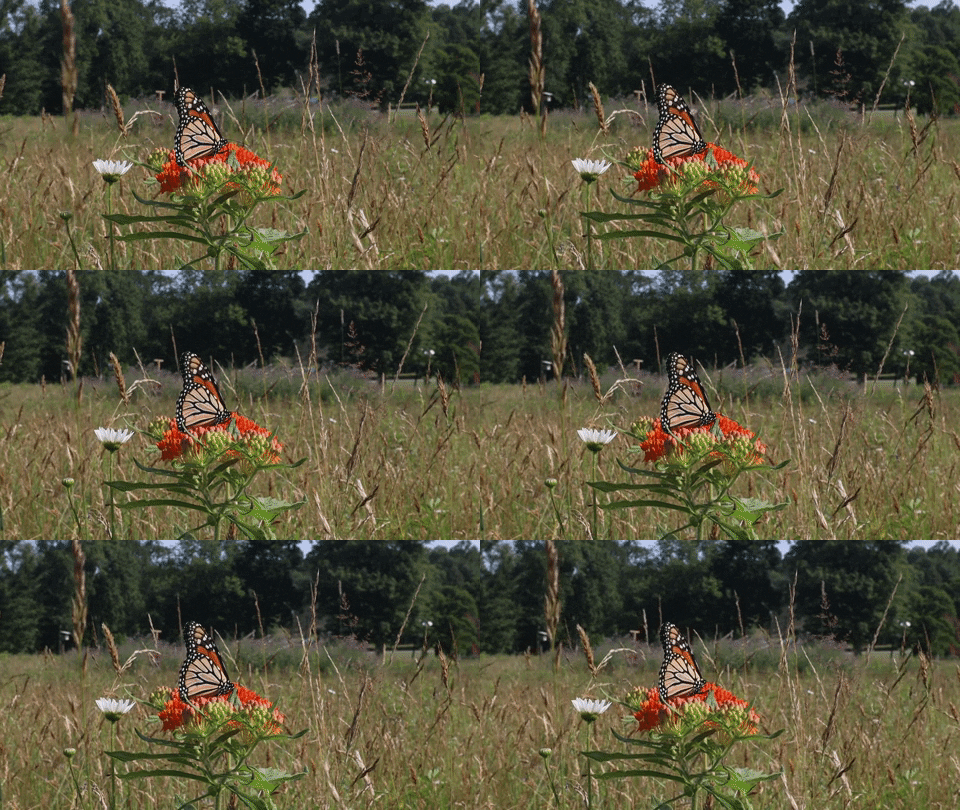

There’s no shortage of wildlife at Foggy Blossom.


3. Illustrate It
By the time we became proper willow people, the process of how to turn it from plant to woven product was a story that we had to tell over and over. It’s a complex process to convey with just words, so after getting asked the question one too many times, I decided to put my drawing skills to the test and create the following infographic, using the digital app Procreate:

We had the image printed on a large board and began taking it to all of our events. Something clicks when people see it, and at the very least, it’s a conversation starter and point of reference.
I return to infographics over and over because they’re just so satisfying to make, and as a visual learner myself it feels important to share information in as many formats as possible. Here’s a recent creation that’ll go out to everyone who buys our cuttings:

4. Play to Your Strengths
In the quiet years (seemingly every one up until 2023), we had so much time to play as we figured out what Foggy Blossom was going to be, if anything. The freedom of having a hobby, rather than a business, allowed us to explore with hardly anyone looking, and it’s from that space that Dan found basketry in the first place.
His strength is working with his hands, ideally outside, and one too many idle winters spent rabbit holing through YouTube led him to what’s now become his chosen craft. But his first baskets weren’t even made from willow, they utilized multiflora rose and blackberry canes, because that’s what was abundantly growing. These experiments weren’t just resourceful, they were a low stakes way to see if it was something he’d ultimately enjoy.

I’m greatly inspired by flowers, and all of the flora and fauna on this land, but also documentation, which in hindsight seems to be my greatest strength.

There’s no shortage of inspiration for both of us here, and as long as we focus on exploring the things we’re good at, and naturally drawn to, the possibilities seem endless.
The entire life of this farm, for better or for worse, is well archived through my images and words, and these Field Notes are the latest iteration of how Foggy Blossom is communicated to the world. Another experiment, another vehicle for finding our truest voice. Looking forward to what we try next.

Originally published on April 7, 2024
Rain-Soaked Renewal
April's Rising Tide of Abundance

Honeybee approaching Lilac, first Morel, drenched Daffodil, and a fruit tree flowering
April has been equal parts rain-soaked and steeped in renewal.
Lilacs and morels reappeared this week, along with asparagus. Our ramps are lusher than ever, the fruit trees are bursting with buds and blooms, and bees are scrambling to suckle honeyberry blossoms before they all fall off.
On a morning when the precipitation took a pause, we took a luxuriously long walk around the acreage, enchanted by it all. Life has been overwhelming lately, so the opportunity to get lost in this month’s rising abundance was a welcome one.

On April 30, 2018, we planted willow for the very first time. We put just three varieties in a corner of our nursery, which were sourced from an experienced weaver selling cuttings through the Seed Savers Exchange. The impetus for planting willow back then wasn’t basketry-related, it was simply because we’d made the decision to pivot our focus from annuals to perennials.

April 2018: Dan putting the very first Foggy Blossom willow in the ground
When we decided that the grind of growing from scratch every year wasn’t a path we wanted to continue, we put every perennial we could get our hands on into the ground in an effort to establish long-term investments. We envisioned future fruit and nut orchards, and a food forest that would hit peak density in tandem with the arrival of our golden years.
The main goal was to establish an incredibly wide variety of species across the acreage. So before we knew willow could be woven, it was just another plant, in a sea of dozens, that took Foggy Blossom in new direction.

Willow stools sprouting back to life
Since 2018, Dan has devoted himself to the craft of basketry, and our willow collection has grown to over 100 varieties across nearly 6,000 plants. Soon we’ll begin our annual planting of new plots, expanding even more. That original corner still stands in the nursery, but now nearly all of our willow is raised in meticulous and measured rows across the fields.
The irony of choosing perennials because they generally only need to be planted once, and then spending labor intensive days each spring increasing our collection of willow via cuttings, is not lost on us.

In addition to our own planting, we’re selling and shipping willow cuttings this month so others can do the same. Many are already on their way to new homes in places like California, Vermont, Iowa, New York City, and more. It’s wonderful, and mind-boggling, to think of all the roots that’ll be spreading far and wide this season.
We’re also currently in the midst of teaching an 8-week basketry class in Pittsburgh, with 7 more workshops on the calendar this year. Dan is diligently working to prepare the willow bundles for each one, and together we’re planning the curriculums and designing supportive materials.
The daily work often seems small and tedious, and our collaboration with willow still feels new in so many ways. In 2018 we never could have foreseen this trajectory, but of course it all makes sense now.

Willow was the perfect plant to rise above that tide of new perennials post-pivot, as it provided ample opportunities for exploration and experimentation, thanks to its overwhelming abundance and rate of growth.
It is the only endeavor that has brought us success in the conventional sense, but on the days that are awash in work, thanks to our primary plant’s prolific nature, we’re grateful for the many examples of tortoise-paced growth all around.

Grapevine bud, Apple blossoms
We’ve only recently begun to see the first inklings of maturity from many of the perennials established alongside those initial willows 6 years ago, and it’ll be longer still before we see yields from other species.
Our fingers are crossed that the inaugural flowers now budding on our Pawpaws will turn into actual fruit this fall, and that the pear, apple, and plum trees will produce heaps, instead of the scant handfuls that came to fruition last year.

Peony buds popping
All of these hopes, however, are reminders that our initial vision was not to pigeon hole ourselves as willow people, but to create a diverse, edible landscape that would unfold with abundance for the rest of our lives.
Willow and basketry has been a wonderfully fun adventure, and will continue to be, but as the wide breadth of Foggy Blossom increasingly wakes up each spring, we hope to inspire, and be inspired, by much more.
Originally published on April 14, 2024
Visitors
Memorable & Magic Spring Encounters

There’s been so much activity around us lately that I’ve wondered if it’s crossing our path on purpose, or we’re simply interrupting the flow.
Whether lucky spectators, or merely witnesses in the way, what we’ve encountered this week has felt especially magical. There was the bat hunting bugs above us as we lounged on the deck one warm evening, admiring its jaggedly swooping silhouette from below. While foraging for morels, a fiery flash at my feet drew me down to a red-spotted newt, who I hadn’t seen since fall. On a nearby trail, both dragonfly and bald eagle soared overhead, and back home the first swallowtail butterfly flickered around.
Thursday morning held an especially monumental encounter. It was a dawn that unfolded after frightfully stormy weather the night before, and had me wandering to one of the more fringe edges of our woods. It’s not an area visited with any regularity, but sometimes it feels as if a force is guiding my way. Following the feeling, which was ultimately leading in the direction of the road, and nothing particularly special, I was stopped in my tracks at the sight of something I’d never seen before.

I immediately called Dan over, taking him away from hazelnut planting in the field. We both stood in awe at the surprisingly silent mass, wondering what to do, and knowing it was safe to linger at a reasonable distance.
Honey bee swarms may seem menacing, but they’re when bees are perhaps most docile. Far from the sanctity of a hive, a swarm is basically a skinless and vulnerable sum of moving parts on a mission to find a new home. Without a residence to defend, a colony is more concerned with building a new one, and surviving the journey, than attacking.

We ultimately made the decision to leave it be, acknowledging that a swarm is the honey bee’s natural means of reproduction, and often interfered with. It was also in a very isolated area, far from human-inhabited structures, and flush with all sorts of trees that could serve as their new hive, which is exactly what happened.
Throughout the afternoon the colony migrated 30 feet skyward to a visibly hollow portion of the tree above them, leaving behind just some wax where they’d hung all morning. Magic.

We see honey bees all the time, especially now, when fruit and flower blossoms are abundantly ripe for the feasting. Blooms from currant, apple, dandelion, cherry, lilac, and many other plants are constantly covered with bees gathering fat lumps of yellow and orange pollen on their hind leg’s “pockets.”
Observing those frenzied moments can make one feel especially in the way, as bees will often swoop past you in close proximity, annoyed at the encumbrance to their quest.

As we experience moments like these, or a mother bird frantically passing us to bring sustenance back to her nest, or spook a sunning frog back into the water, or send a snake slithering down a hole away from our looming presence, it’s more and more obvious that we are the visitors to this land.
All of this activity would go on without us, and will outlive us, but I do like to imagine that we’ve cultivated such a cozy space during our tenure here that all types of beings feel welcome to make it a home.
They certainly make us feel rooted, and part of something much bigger.

Originally published on April 21, 2024
Arrivals & Departures
Observations at the End of April

With April departing, it feels as if spring can fully arrive.
It’s taken all month to find a steady rhythm of regeneration, but there’s no stopping it now. A growing density of green continues to blend the trees together, cloaking their naked off-season individuality into an infinite blur of verdant foliage.
The morning sun increasingly pierces our windows with renewed vigor, and lengthier days unfold in shadows that shift across the grass in long forgotten patterns. Fruit, flower and nut blossoms are stretching open with increased confidence, as our own bodies continue to slough off the softness of stagnancy.
Slowly, strength and stamina are returning.

slightly frosty blueberry blossoms
Freezing temperatures continued to visit us throughout this past week, thwarting the annual ache to touch bare feet to the earth and feel cool freedom after being swaddled by socks for so long. Frost, ignoring the music that’s been playing it off, clung around the edges of soft blueberry blooms and left daffodils translucent.
Thankfully, nothing seems to have been affected too greatly. Hopefully, we’re beyond the grip of dipping mercury.

Blueberry blossoms happily basking in the sun
We’ve been busy establishing new willow plots, mowing our endless lawn, and continuing to care and prepare for the needs of our current and upcoming students. Amidst all the chores and maintenance, in all the wishing for warmth, and cursing of cold, there is more than just the long awaited gesture of brushing the landscape from brown to green.

Irises emerging amongst grape hyacinth
Spring feels like a doorway from which we can learn to see, hear, feel and touch the metaphorical roses, before it’s time to smell them. It is an education in subtlety, and patience, that often arrives in a dance that feels two steps forward, three steps back.
The jerky tempo reminds us to do our due diligence, and attune to what’s present in every moment - not what we wish was, or wasn’t, here.

I say that April’s exit means that spring can fully arrive, but of course it’s been here since it first arrived 40 days ago. The archetypal imagery of spring, however, is all blossoms, and babies, and sprouting seedlings, which only now are stepping into view.
But perhaps the fullness of anything requires a gestation period of freezing and thawing before it can mature into the full manifestation we may have in our mind’s eye. Of course it does, but I’m glad we’re beyond the beginnings that often feel barely there.
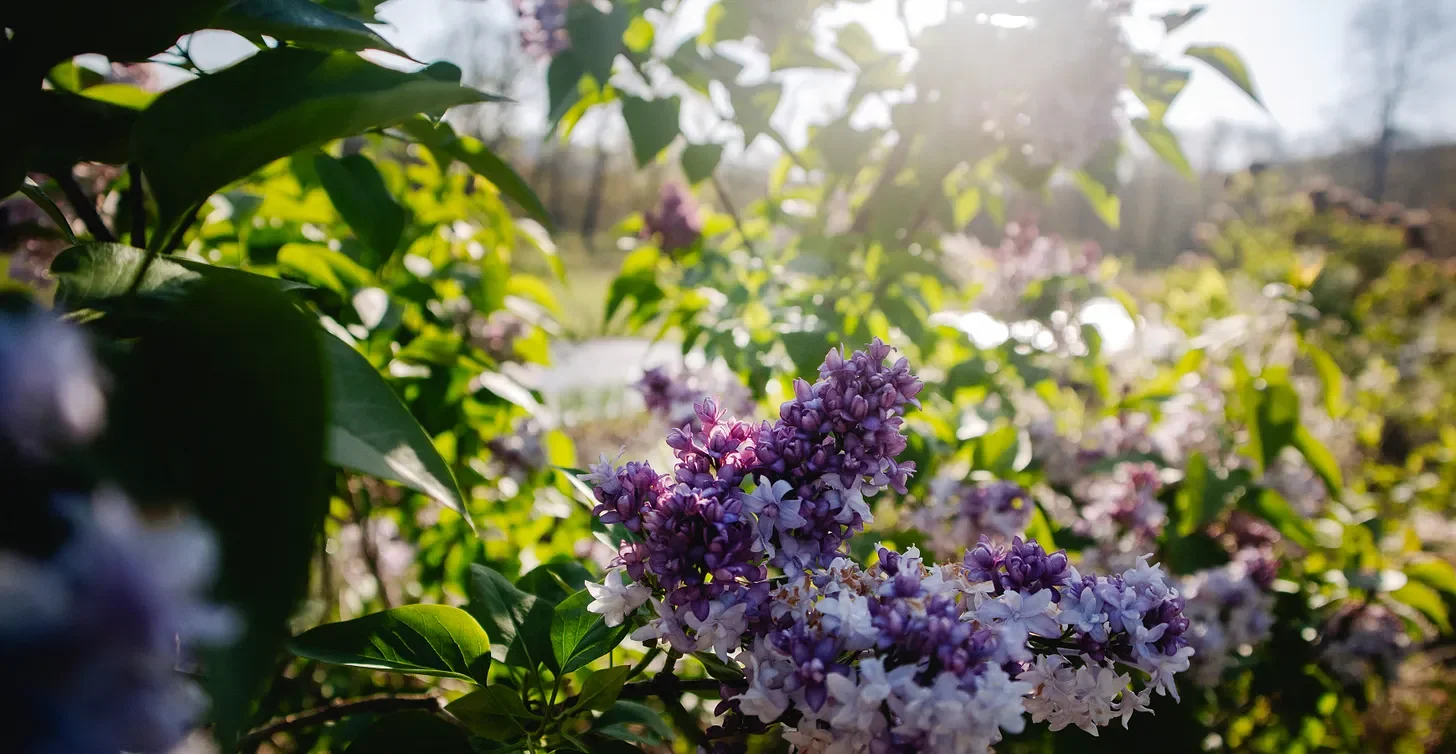
Lilacs, always lovely